Raw Materials Guide

A Thorough Comparison of Powdered Agar and Thread Agar: Characteristics, Uses, and How to Choose

March 10, 2026

Table of Contents

<a href=Powdered agarA thorough comparison with thread agar | Features, uses, and how to choose explained” style=”width: 100%;height: auto;margin-bottom: 20px; max-width: 100% !important; height: auto !important; display: block; margin: 0 auto 20px;” />

Powdered agar or thread agar—which should you choose?

When you set out to make wagashi, the first thing you agonize over is how to choose the agar. Powdered agar and thread agar are both made from the same seaweed, so why are there so many types?

In fact, the type of agar greatly changes the finished texture, transparency, and ease of use.

In this article, we thoroughly compare the differences between powdered agar and thread agar from the standpoints of form, solubility, texture, and use, and introduce tips for making wagashi that leverage each one's characteristics.

See Minoyo's Product List Here


Basic Knowledge of Agar | Raw Materials and Production Method

テングサとオゴノリの海藻原料

Agar is a gelling agent made from red algae seaweeds such as tengusa and ogonori.

Dehydrating and drying tokoroten makes agar. Agar and tokoroten are made from the same raw material, but because the production processes differ, they are treated as entirely different foods.

The Difference Between Natural Agar and Industrial Agar

Agar can be broadly divided into two production methods. "Natural agar," made by the old-fashioned method of natural freezing and natural drying, and "industrial agar," produced in a factory.

Thread agar and bar agar are classified as natural agar and use tengusa as the main raw material. Powdered agar, on the other hand, is mostly industrial agar, using ogonori as the main raw material, dehydrated under pressure, then dried and ground.

This difference in production method greatly affects texture, flavor, and ease of use.


Features of Powdered Agar | Convenience and Strong Gelling Power

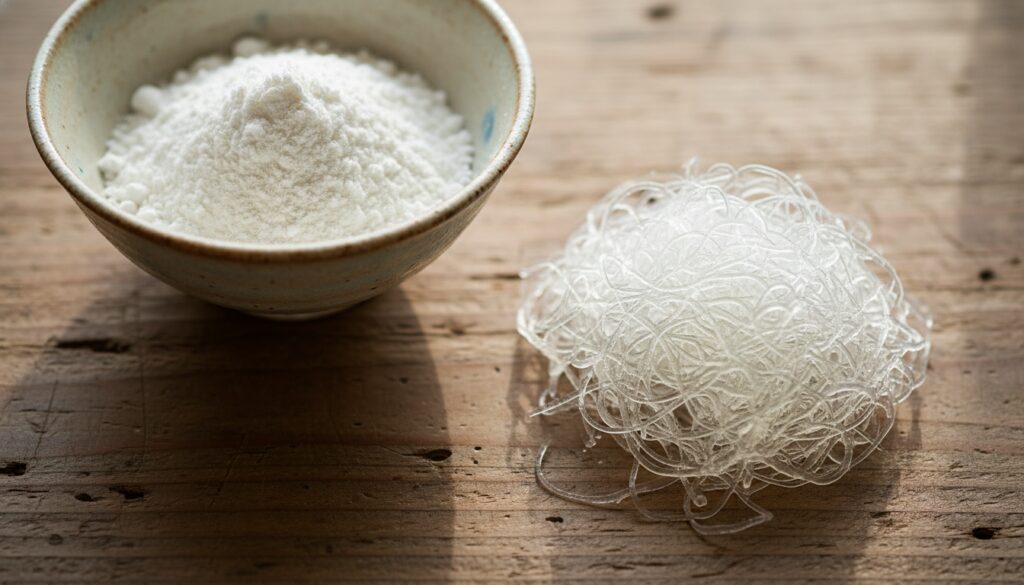
粉末寒天のパウダー状態

The Convenience of Being Usable Without Soaking

The greatest appeal of powdered agar is that there is no need to soak it in water—you can use it as is!

Because it can be dissolved simply by adding it directly to cold water, mixing, and then heating, it is an easy agar to handle even for beginners. It is easy to measure and easy to store, so it is widely popular for home use.

Strong Gelling Power and a Somewhat Firm Finish

Powdered agar has very strong gelling power and can set a large amount of liquid with only a small quantity. However, compared with thread agar and bar agar, its elasticity is weaker and it finishes somewhat firm.

Its transparency is inferior to natural agar, but the seaweed odor is also weaker, giving it a light, clean taste.

It can be used for a wide range of applications, including mizu-yokan, annin tofu, and jelly.


Features of Thread Agar | Smoothness and Transparency

100% Tengusa, an Agar for High-End Wagashi

Thread agar is a thread-shaped agar made mainly from tengusa by the old-fashioned method of natural freezing and natural drying. Because various components contained in tengusa remain, it has a strong seaweed-like odor and strong elasticity.

It is said that professional wagashi shops are particular about using thread agar, and it is the ideal agar for making yokan.

A Smooth Mouthfeel and High Transparency

Thread agar is unrivaled in its viscosity and is also smooth. It has high transparency and a delicate mouthfeel, making it suitable for wagashi.

When using it, you need to soak it in plenty of water for 2 hours or more to rehydrate it. When dissolving it by boiling, 30 minutes or more of soaking is the guideline.

Squeeze the rehydrated thread agar well to drain the water, place it in a pot, and boil until no lumps remain to dissolve it. It is used in producing high-end wagashi such as yokan, kingyoku, and mizu-yokan.


Comparison Table of Powdered Agar and Thread Agar

Item Powdered agar Thread agar
Raw material Ogonori (main) 100% tengusa
Production method Industrial process Natural freezing and natural drying
Soaking Not required Required (2 hours or more)
Gelling power Very strong Strong
Texture Somewhat firm Smooth, with elasticity
Transparency Somewhat inferior High
Odor Weak Has a seaweed aroma
Use Home use / general purpose For high-end wagashi

Powdered agar is prized for its convenience and strong gelling power, making it ideal for beginners and home use. Thread agar (ito-kanten), on the other hand, is characterized by its smooth texture and high transparency, and is favored by professional wagashi (traditional Japanese confectionery) artisans.


How to Choose|Selecting by Application

For casual home use, choose powdered agar

Powdered agar requires no soaking to rehydrate and can be used as is, making it perfect for those who want to enjoy making wagashi casually amid a busy daily routine.

It is easy to measure and simple to store, so keeping it on hand is convenient. It works for a wide range of recipes, including almond tofu, mizu-yokan (soft summer jelly), and fruit jelly.

For authentic wagashi making, choose thread agar

If you are after a beautifully transparent finish and a smooth texture, choose thread agar. It does take time to rehydrate in water, but in return you can enjoy a refined texture and flavor.

Thread agar is ideal for wagashi where visual beauty is essential, such as neri-yokan (firm bean jelly), kingyoku (clear jelly), and kohaku-to (crystallized agar candy).

Using fresh thread agar makes the finished product noticeably more delicious in terms of texture and mouthfeel.


How to Use Agar and Points to Note

寒天を煮溶かす調理工程

How to use powdered agar

Add the powdered agar to the measured amount of water and bring it to a boil to dissolve. Once boiling, lower the heat and continue to simmer while stirring for 1 to 2 minutes to dissolve the agar thoroughly.

Once the agar has completely dissolved, add sugar and continue heating to dissolve it. Note that adding sugar before the agar has dissolved makes the agar harder to dissolve.

How to use thread agar

Cut it into suitable sizes and soak it in plenty of water for about 2 hours to half a day. Once the core has softened and disappeared, drain off the water.

Add the rehydrated thread agar to the measured amount of water and bring it to a boil over medium heat while stirring. Once boiling, lower the heat and continue to simmer while stirring for 1 to 2 minutes to dissolve the agar thoroughly.

With bar agar and thread agar, straining through a sieve gives a smoother finish.

Points to note to avoid failure

If the agar is not completely dissolved, not only will the texture suffer, but the gelling power will also weaken. Bring it to a boil and dissolve it thoroughly.

Boiling agar together with strongly acidic juices and the like can prevent it from setting. When adding such ingredients, turn off the heat before adding them.

When a large amount of liquid is added later, if it is cold the temperature drops sharply, causing uneven setting. Bringing the liquid to be added later to room temperature or body temperature helps avoid failure.


Summary|Choose the Agar That Suits You

Powdered agar and thread agar each have their own appeal. Choose powdered agar if you want convenience and strong gelling power, and thread agar if you want a smooth texture and high transparency.

Using them appropriately according to the application and purpose broadens the scope of your wagashi making.

At Minoyo, we offer a wide range of high-quality raw materials essential for making wagashi, including thread agar and powdered agar.

See Minoyo's Product List Here

📦 Related Minoyo Products

Please feel free to consult us about commercial procurement and sample requests

Minoyo is a specialty store for Kyoto confectionery raw materials based in Kyoto. For the raw materials covered in this article, we offer proposals close to the realities of wagashi production, including commercial procurement, trial samples, and consultation on lots and specifications.

For Minoyo's business and strengths, please see Our Business & Why We Are Chosen . For the actual flow of doing business, see Ordering Process & How to Order; for questions, we have compiled them at Frequently Asked Questions . For individual consultations, please use Contact or material download to get in touch.

Related Articles

What Is Cacao Allergy? A Guide to the Three Types of Causes and How to Choose Alternative Ingredients

We explain the main causes of cacao allergy (the cacao bean itself, sub-ingredients, and cross-contamination) and how to choose alternative ingredients. From flavor-profile comparisons of carob, soy cacao, and Japanese ingredients to allergen management in product development and OEM, we organize it all from the perspective of Minoyo, which has handled Kyoto confectionery raw materials for 120 years.

Halal Chocolate Ingredients and Certification | A Business-Focused Guide Including Cacao Alternatives

We comprehensively explain the ingredient design and certification points for halal chocolate, covering emulsifiers, dairy, sweeteners, and cacao alternatives. From the appropriate use of certification bodies such as JHA, JAKIM, and BPJPH to the decision criteria for OEM consultations with export channels in mind, we organize it all from the perspective of Minoyo, which has handled Kyoto confectionery raw materials for 120 years.

Latest Articles

Categories

Tags

Request Materials & Contact​

Please feel free to reach out with any questions about raw materials or products, or to request materials.
Our dedicated staff will respond with care.